

The U.S. housing market has been characterized by bidding wars, meteoric home prices, and intense competition among buyers over the past years. The difficulty in finding a home frequently involved submitting bids greater than the asking price and out-bidding other bidders. But today the market is telling a much different tale.
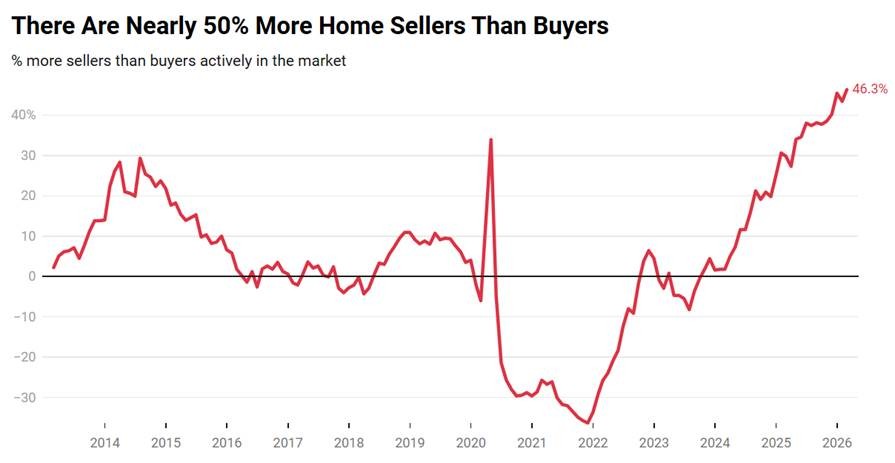
Based on the new housing market statistics, home sellers have surpassed buyers by almost 630,000, the largest gap in history. The number of sellers was about 46.3% higher than buyers in February 2026, an unprecedented imbalance that indicates a significant change in the market dynamics.
Although this can be perceived as good news to buyers, the actual situation is not that simple. The housing market can be moving towards the buyer’s side; however, affordability is a significant barrier to most Americans utilizing the opportunity.

The Biggest Buyer-Seller Gap on Record
The recent statistics indicate that there are many active sellers of homes, as compared to the active buyers. Redfin estimates that there were roughly 1.99 million sellers compared to just 1.36 million buyers in February 2026. This difference of almost 630,000 is the largest since the records started in 2013.
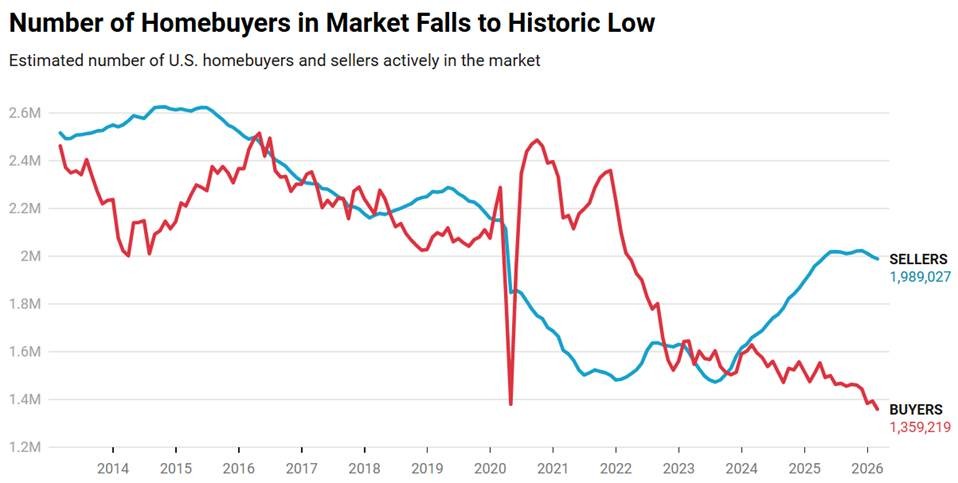
According to the conventional housing industry standards, this is definitely a buyer’s market. As a rule, when there are more sellers than buyers by a margin of over 10%, buyers become able to negotiate since they have a wide range of options at their disposal. The existing gap exceeds such a threshold by more than four times.
This is a dramatic turnaround to the pandemic era housing boom where the low mortgage rates and low inventory placed sellers in a great position. The buyers at that time had to deal with bidding wars and soaring prices.
The balance of power is changing now.
Why Buyers Are Staying on the Sidelines
The glaring question is: why are not buyers jumping in, when there are so many homes to buy?
It all boils down to price.

Even though there is an increase in housing inventory, homeownership is still costly. Mortgage rates are creeping higher than 6%, which means that monthly payments are high in comparison to a few years back. Together with high house prices, most prospective customers simply do not have the money to venture into the market.
Uncertainty in the economy is also contributing. The issue of inflation, job security, and the economy at large have caused most households to be cautious about committing themselves to large financial commitments. This has led to low buyer activity, which has not been observed since time immemorial.
That is, the number of homes on sale might increase, but the affordability issues are likely to keep a large number of buyers out of the market.
More Sellers Are Entering the Market
Meanwhile, the sellers are increasing.
One of them is the slow release of the so-called mortgage lock-in effect. Over the last few years, most homeowners were reluctant to sell since they were stuck in extremely low mortgage rates that they acquired during the pandemic. Selling their houses would have implied buying a new house at greatly increased interest rates.
Nevertheless, life situations eventually compel individuals to relocate. More homeowners are listing their homes despite the increase in the cost of borrowing because of job changes, family needs, divorces, relocations and retirements.
Moreover, numerous areas witnessed a boom in new building in the pandemic housing boom. The constructors were in a hurry to satisfy demand, especially in booming Sun Belt markets. With the demand having abated, such markets are experiencing increasing inventory and more desirable homes.
Price Cuts Are Becoming More Common
The growing price cuts are one of the most evident indicators of a shifting market.
According to new housing statistics, over a third of home sellers have lowered their selling price, the highest rate of price reduction in over ten years. In certain situations, the average decrease is over $40,000.
This is an indication that a large number of sellers are starting to realize that the market is no longer the same. The buyers are now more powerful, more options, and not as urgency as they were in the housing frenzy of 2020 through 2022.
Nonetheless, prices are not falling all over the country. Most vendors will not be eager to reduce their prices to an extent particularly those who bought homes at elevated prices over the last years. This is developing a stalemate between the consumers who want to be able to afford and the sellers who want to maintain their equity.
Where Buyers Have the Most Power
The change is not occurring uniformly nationwide.
The market data has indicated that the buyer markets of some of the strongest buyers are in the South like Miami, Nashville, Austin, West Palm Beach and San Antonio. These regions experienced a high level of construction during this time of the pandemic and are currently overloaded with vacant housing.
In the meantime, certain Northeastern markets are still relatively competitive because housing supply is tighter. In other places, such as Newark, Nassau County and parts of Pennsylvania, there is still less inventory in relation to buyers than in other areas.
This points out to a key fact that although national trends may have some insights, housing is a very local market.
What This Means for the Housing Market in 2026
The widening disconnect between buyers and sellers implies that the housing market is in a new stage. The bargaining power of buyers is more than it has been in years, yet affordability stands as a significant obstacle.
Assuming mortgage rates remain high and the economy remains unstable; sellers might end up having to pressure to decrease prices or give incentives so that buyers will buy their properties. Concurrently, when the rates start falling, some of the buyers who are currently sitting on the sidelines may move back into the market and this would help in restoring equilibrium.
Currently, the housing market is in a very uncharacteristic situation where the change in inventory is increasing and demand is low. This mix is fostering one of the most buyer-friendly climates in more than ten years-at least among the people who are able to afford to get into the game.
Finance Gossips Takeaway
America’s housing market is undergoing one of its biggest shifts in years. Having almost 630,000 more sellers than buyers, it is evident that the balance of power has shifted significantly towards the buyers and not the sellers. Nonetheless, mortgage rates remain high, and unaffordability is still hindering many Americans to utilize the opportunity.
It is probable that the next several months will define whether this imbalance translates to the more extensive price adjustments or lower interest rates resumes the consumers to the market.
Wish to keep up with the most recent housing market news, mortgage news and economic news? Become a member of Finance Gossips and receive professional analysis and breaking financial news right into your hands.

