For much of the past two years, inflation has dominated conversations among consumers, businesses, and policymakers.
Inflation has become one of the greatest economic issues in the world due to rising food prices, high costs of borrowing, high fuel prices, and continued uncertainty.
In the recent past, however, there has been some good news. The U.S inflation slowed down in June, providing relief to consumers and financial markets, which have been experiencing high levels of price pressure.
However, just as one inflation problem seems to be dying, another is coming into existence–one that is fueled by artificial intelligence.

The Associated Press reports that AI infrastructure has been driving new cost pressures throughout the economy in response to massive investments.
The cost of constructing data centers, acquiring sophisticated processors, increasing electrical capacity, and creating AI systems is expected to cost the technology firms over $700 billion this year.
On the one hand, these investments are likely to promote innovations and long-term economic growth; on the other hand, they are putting pressure on the scarcity of key resources, which makes even semiconductor chips (or electricity) more expensive.
Economists caution that these increasing prices may continue pushing inflation levels high until the end of the year.
This is a very interesting economic paradox. The long-term productivity and efficiency of AI will be more productive and efficient, but the competition to create
AI infrastructure can push the costs up in the short term before these long-term advantages are completely realized.
Inflation Is Finally Showing Signs of Relief

June was promising with regard to inflation after months of inertial price growth. Consumer prices dropped by 0.4% since May, the biggest monthly decrease in four years, decreasing the annual rate of inflation at 3.5%.
The improvement was because of lower gasoline prices, low-cost used cars, and falling clothing prices. To consumers, the data indicated that certain inflationary pressures that had a hold on household budgets were starting to subside.
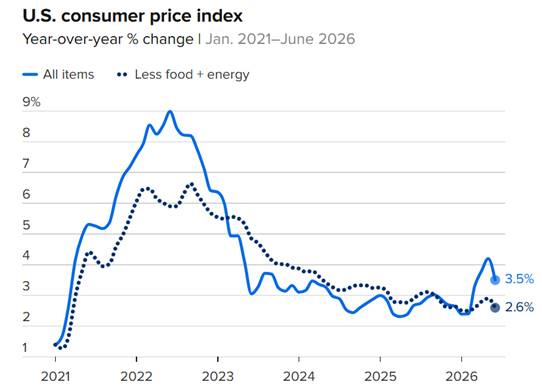
The news was received well by financial markets as slower inflation pressures the Federal Reserve to keep interest rates high. Reduced inflation normally provides an atmosphere that favors consumer spending, business investment, and economic growth.
Nevertheless, only a few factors can lead to inflation. New cost pressures may soon arise as the stabilization of energy prices and supply chains can create new cost pressures. Artificial intelligence seems to be making the list in 2026.
The AI Infrastructure Boom Comes with a Price
AI has emerged as one of the biggest themes of investment in the world. Technology giants such as Microsoft, Amazon, Alphabet, Meta, and other big companies are investing more than ever in AI data centres and computing infrastructure.
These centers demand colossal amounts of sophisticated processors, memory chips, networking devices, cooling systems, and power.
This spurt of spending has greatly boosted demand for specialized computer hardware, according to AP, which has pushed semiconductors and other related equipment up in cost.
The pressure of such AI data centers is also increasing on utilities, which are now investing in power generation and grid infrastructure due to large-scale electricity consumption.
This new pressure is unlike the traditional one that is caused by consumer demand, but by corporate investment. With businesses competing to create more powerful AI systems, they are in effect bidding higher prices for the important technology components.
The consequence is a ripple effect which may spread across the economy, causing a rise in the costs of production among manufacturers, technology providers, and businesses that depend on sophisticated computing equipment.
Why AI Could Delay Interest Rate Cuts
Inflation is closely monitored by central banks as it has a direct impact on the interest rate decisions. Should the escalation of prices proceed at a rate higher than anticipated, the policymakers can wait before implementing the planned reduction of the rates or even contemplate further tightening to ensure that inflation does not take root.
Even though June had a positive inflation report, economists are not optimistic since investment based on AI can cause some perennial price pressures in the later months this year.
The recent gains in curbing inflation could be counterbalanced by the huge expenditures on chips, processors, data centers, and electricity.
Increased interest rates impact the economy in almost all aspects. Mortgage rates are still high, and it is more expensive to borrow, so businesses and consumers tend to spend less on discretionary spending.
Although the trend of inflation may be overall gradualizing, the rise in costs due to AI may make the Federal Reserve work harder to bring the inflation rate back to its long-term target entirely.
This implies that investors will not only consider consumer demand but also corporate investment trends, which are emerging as a significant driver of economic conditions.
The Long-Term Benefits Could Outweigh Today’s Costs
Although the economy may experience short-term inflation, not many economists doubt the long-term economic potential of AI.
Artificial intelligence can enhance productivity in any industry, streamline repetitive processes, optimize supply chains, speed up scientific research, and develop completely new business models.
Historically, significant technological revolutions could require a massive initial investment and only produce many wide economic benefits later.
Railways, electricity, the internet and cloud computing all entailed long durations of intense capital expenditure and afterwards yielded long-term productivity returns.
The AI revolution seems to be on the same route. The investments today will cause a temporary rise in costs but might, in the long run, make businesses run more efficiently, reduce production costs, and enhance overall economic productivity.
The difficulty facing policymakers is how to cope with this change without letting temporary inflation caused by investments turn into a more permanent issue.
What Investors Should Watch
The crossroads of artificial intelligence and inflation are probably going to continue being one of the most followed economic topics in the next year.
Some of the key indicators that investors are to keep an eye on are the prices of semiconductors, electricity demand, expenditure on AI by corporations, reports on inflation, and Federal Reserve policy decisions.
Firms providing AI infrastructure, such as semiconductor companies, cloud providers, and energy firms, might keep enjoying a healthy demand. Simultaneously, the companies that are highly reliant on technology equipment may experience increased operating expenses.
Greater geopolitical processes are also significant. An increase in oil prices due to the tensions with Iran can be another source of inflationary pressure, which is an additional challenge to policymakers who already have to balance AI-based investment with declining consumer inflation.
To investors, it will be important to know how these forces will interact in the assessment of the opportunities in the technology, infrastructure, energy and financial markets.
Finance Gossips Takeaway
The impact of artificial intelligence on the world economy is a lot more than just technological. Although AI has a brighter future of increased productivity and greater growth in the long term, the enormous investment needed to establish the infrastructure behind it is causing new inflationary pressures today.
This recent fall in inflation is a welcome reprieve, but policymakers and investors are now faced with a new economic reality in which higher prices can be stimulated in the short term by technological advances themselves.
With the pace of AI adoption in any industry, the impact will go beyond innovation as it will shape inflation, interest rates, and corporate profits over the coming years and investment prospects.
Subscribe to Finance Gossips to get the best analysis in the field of AI, inflation, international markets, and economic trends that are shaping the financial future.