Oil Prices Surge Over 3% as US-Iran Conflict Escalates
What It Means for Global Markets
When it comes to oil, global markets are back on edge, and oil is spiking once again due to renewed military tension between the United States and Iran.
After weeks of cautious optimism that tensions in the Middle East were easing, fresh airstrikes and retaliatory attacks have reignited fears of a major supply disruption, reminding investors just how sensitive energy markets remain to geopolitical conflict.

The two major benchmarks for oil in the world, Brent crude and West Texas Intermediate (WTI), rallied by over 3% after reports of new military attacks in the area.
The abrupt surge is indicative of rising fears that the war could punish oil flows through the Strait of Hormuz, one of the world’s most vital energy passages. This narrow stretch of water is vital to the world’s energy supply, with millions of barrels of crude oil passing through each day.
Any disruption in shipping immediately sparks worries over shortages and increasing prices.
The latest developments are another reminder to anyone who deals in oil that the price of oil does not depend on supply and demand alone. Political tension, war, and uncertainty in the major oil-producing areas can rapidly impact movements.
Why Oil Prices Are Rising Again
The latest surge came after the U.S. conducted more military strikes against Iranian targets. Iran backlashed by further efforts to hit U.S. targets and Gulf states while threatening additional strikes.
The renewed conflict has heightened concerns that the fragile diplomatic process achieved over the past few weeks may quickly unravel.

The conflict is not just a concern of markets; it’s the prospect of how it could affect energy transportation. Iran has long threatened action around the Strait of Hormuz, a waterway that transports about one-fifth of the world’s oil.
While commercial shipping has not ceased, it has been reported that vessel traffic has slowed considerably as shipping companies consider the increasing security threats.
When the situation is unclear about this important trade route, oil traders promptly add a “risk premium” to oil prices. The fear of future disruption is enough to send prices up even if actual oil production is unchanged.
The Strait of Hormuz Remains the Biggest Concern
The Strait of Hormuz has been regarded as one of the most strategically important straits in the world for a long time.
It forms a link between the Persian Gulf and the world markets and is the main export artery for leading oil producers such as Saudi Arabia, Iraq and Kuwait, the United Arab Emirates and Iran.
With most of the world’s crude oil going through this strait, any military move in the region has an impact on market sentiment. Even if the delays in shipping are temporary, investors are worried that they will affect the global supply chain and drive up transportation expenses.
Recent reports indicate that commercial vessel movement has already been significantly reduced since the last attacks, despite U.S. officials saying that the waterway remains open.
Meanwhile, Iran is warning of possible more incidents in the future, which further adds uncertainty to shipping firms and energy traders.
It illustrates the rationale for oil markets to anticipate oil shortages rather than reacting to them. Expectations are often as strong as reality in energy trading.
What Higher Oil Prices Mean for the Global Economy
A rise in oil prices typically does not impact just the energy industry. Oil prices tend to have a trickle-down effect throughout the economy because of their use in transportation, manufacturing, agriculture, aviation, and a host of other industries.
As oil prices rise, business expenses tend to increase. Users of these products pay higher prices for fuel, logistics service providers incur higher costs for goods, and manufacturers experience higher production costs. Most of these extra expenses translate into increased consumer costs over time.
This is one of the reasons why central banks are keenly interested in the energy market. High and sustained oil prices have the potential to drive inflation, making it harder for policymakers to lower interest rates.
However, if inflation starts to tick up again due to rising energy prices, the Federal Reserve and other central banks could opt to leave borrowing rates elevated for an extended period.
As a result, higher interest rates can impact everything, from home mortgages to business loans to stock market activity—and one geopolitical conflict can have an impact on the global economy.
What Investors Should Be Watching
The greatest uncertainty is whether the current war will continue to be one of escalation or whether the diplomacy will be successful in avoiding additional military involvement. As long as tensions ease, oil prices may fall back relatively rapidly because of the decreasing worries over supply interruption.
But if the attacks persist or the shipping through the Strait of Hormuz is further curtailed, analysts believe oil prices could stay high or even go higher.
Other key focus areas include inventory levels, OPEC+ production announcements and demand from the world’s biggest economies like China and the United States. Short-term oil prices fluctuate with geopolitical events, but supply and global economic activity will ultimately have an impact on long-term oil prices.
Higher crude prices could help energy companies, oil producers and commodity investment companies, but may add costs to heavy fuel users like airlines, shipping companies and transportation businesses.
In the current market conditions, diversification has become crucial as well. During geopolitical uncertainty, commodity prices can see significant fluctuations, so it is particularly important to have well-diversified investment portfolios.
Could Oil Reach $100 Again?
As tensions escalate, a question that is gaining more traction is whether crude oil will be able to move back to $100 per barrel.
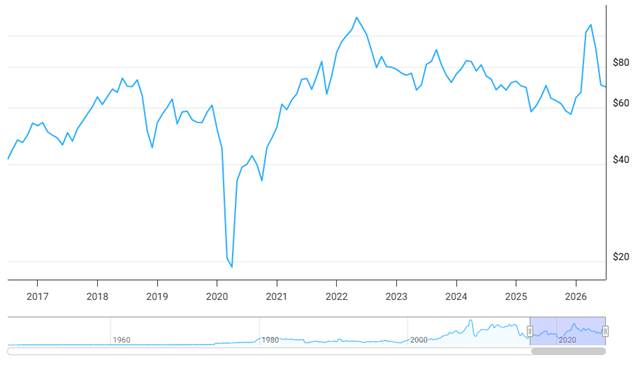
Brent crude oil prices (2016–2026), highlighting the sharp price surge following renewed geopolitical tensions in the Middle East in 2026.
Source: MacroTrends
No one knows how prices will ultimately turn out, but many experts have opined that extended disruptions in Middle East exports would drastically reduce global supply. A significant reduction in shipping through the Strait of Hormuz, by itself, for a prolonged period, could push oil prices very high.
Other factors might constrain additional improvements. The IEA recently highlighted rising global oil production, with some producers outside the Middle East maintaining their output growth. More supply from these areas would be required to compensate for any disruption, but it would be very challenging to replace all the Gulf supply.
So far, markets are driven by headlines, not long-term fundamentals. Each diplomatic development or military advance could result in another oil price swing.
Finance Gossips Takeaway
The current price spike in oil underscores the way the world quickly turns upside down when geopolitical tensions rise. The recent surge was driven by the renewed U.S.-Iranian conflict, but the main theme is the uncertainty. Shrewd investors are not just responding to what is happening around them, but they are taking into account the risk that supply could be disrupted in the future, impacting economies globally.
How the war unfolds over the next few weeks will be a key factor in determining if oil prices will keep rising. Stabilization of markets may occur in a successful diplomatic effort. As tensions continue to rise, more price pressures on energy could prove to be another obstacle for enterprises, consumers and central banks already struggling with a very tough economic climate.
Interested in being the first to know about the latest developments in the oil market, the global economy and investment insights? To enjoy expert analysis, breaking financial news, and market updates straight to you, join Finance Gossips today.