
What It Means for Investors and Digital Assets?
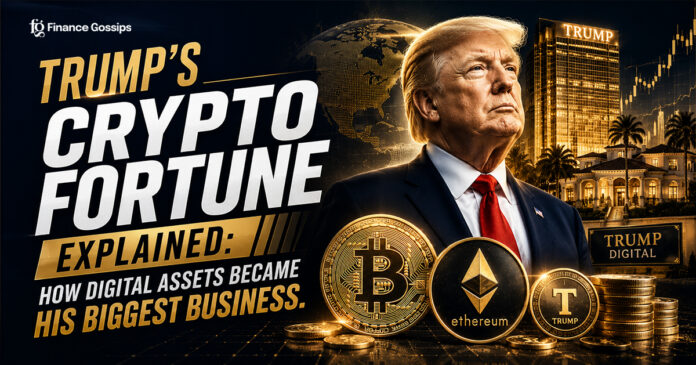
Just a few years ago, Donald Trump was openly dismissive of cryptocurrencies, calling Bitcoin a potential threat to the U.S. dollar and doubting the long-term worth of digital assets. In 2026, the story is very different. The latest financial statements suggest that cryptocurrency is now one of the largest sources of personal wealth for Trump, raising more than $1 billion dollars by selling tokens individually, decentralized finance initiatives, and his meme coin, which the media heavily covered. It is a great change, not only due to the magnitude of the profits but also due to the speed with which cryptocurrency has transitioned to the periphery of the financial system and into the focus of political and economic discourses.
The swift expansion of the Trump crypto empire has elicited positive emotions among its fans, who consider it evidence of the fact that digital assets are becoming mainstream. Meanwhile, it has posed challenging questions to ethics, regulation, and the association between political influence and financial gains. No matter their political position, there is one fact that is becoming more evident each day: cryptocurrency has ceased being an investment fad. It has become such a significant economic power that it is shaping governments, financial markets and international business.
From Crypto Critic to Crypto Billionaire
The attitude of Donald Trump toward cryptocurrency has shifted in recent years. In his first term as president, he had already raised concerns regarding Bitcoin and other digital assets, stating that they posed competition to the U.S. dollar and could be used to facilitate illegal financial transactions. Such remarks were indicative of a larger cynicism that was prevalent among policymakers then.

But the scene in the cryptocurrency industry has since evolved significantly. Bitcoin exchange-traded funds have increased their presence in the market, institutional investors have entered the market, and blockchain technology has become increasingly part of mainstream finance. Instead of staying on the outskirts, Trump and his family welcomed this change by initiating a couple of crypto-related projects, becoming key players in one of the fastest-evolving industries globally.
Such investments are now among the most lucrative entities in the Trump business portfolio, making him even more famous than a lot of the more conventional real estate projects.
Where Trump’s Crypto Wealth Comes From
Most of the reported cryptocurrency revenue of Trump is attributed to two big projects: World Liberty Financial and the $TRUMP meme coin.
World Liberty Financial is a decentralized finance (DeFi) platform that was created in collaboration with Trump family members. The project is dedicated to financial services based on blockchain, such as issuing tokens and infrastructure for digital payments. As financial disclosures reveal, token sales brought in hundreds of millions of dollars in revenue, thus making it one of the most successful politically-linked crypto projects that have ever been launched.
The second significant one is the $TRUMP meme coin, which gained tremendous publicity after its launch. Similar to numerous meme coins, its value has mostly been pushed by market sentiment, community participation and speculation as opposed to more conventional financial underpinnings. There are great gains in the initial investors and high losses among those who joined the market subsequently because the prices became volatile and rose dramatically.
Collectively, these initiatives have made cryptocurrency the highest declared income of Trump, demonstrating how digital assets have not only been moved from a speculative investment into a business with the potential to earn real-world income but also become a business with the potential to earn substantial income.
How Politics and Crypto Are Becoming More Connected
The success of cryptocurrency under Trump has inevitably caused a greater debate on the connection between politics and digital assets.

His administration has mostly taken a more crypto-friendly stance since coming back to power than earlier administrations. Regulators have acted to offer more certainty to digital asset firms, a number of enforcement actions have been scaled down, and legislators have made progress on creating more foreseeable principles regarding stablecoins and blockchain organizations. Proponents believe that the policies promote innovation, draw investment and aid in keeping America ahead in financial technology.
Critics, however, doubt whether the policymakers ought to be entitled to personal gain from industries that they are supposed to control. Ethics pundits have also questioned whether positive cryptocurrency policies would indirectly raise the worth of any businesses associated with the president or his family. The white house has denied these accusations, asserting that the management of Trump assets is not linked to the decision-making on policy and that all decisions are being made in the national interest.
No matter the political view, the debate indicates the extent to which business interests and public policy can be tied up closely as the new technologies transform the economy.
What This Says About the Future of Cryptocurrency
There is something far bigger about the cryptocurrency industry itself than the political headlines, which Trump has disclosed in terms of his own financial disclosures.
Over the years, critics have dismissed crypto as a mere speculation driven by retail investors looking to make rapid gains. Although speculation is definitely still a part of the market, the current crypto ecosystem is much different from what it was in its inception. International payments are being made with stablecoins, platforms based on decentralized finance are providing lending and borrowing services, and tokenization is starting to transform traditional financial markets.
Megabanks, payment firms and asset managers have all become more active in blockchain technology. The governments are considering central bank digital currencies, and institutional investors are increasing their involvement in digital assets.
The billion-dollar crypto income of Trump shows the extent to which this developing ecosystem is profitable. Instead of basing the income on the increase of token prices, firms are now earning money from financial products, transaction fees, issuance of tokens, and blockchain infrastructure. The industry is slowly shifting away from speculation and towards constructing long-term business models that are more reminiscent of traditional financial services.
Lessons for Investors
The story also offers several important lessons for investors following the cryptocurrency market.
To begin with, it demonstrates the speed with which wealth can be generated in new industries. The technology of blockchain is undergoing a fast pace of development, and firms within the market have enjoyed growing institutional usage and clarity in the regulatory environment.
Second, it emphasizes the need to be aware of risk. As Trump’s business projects had brought in super-profits, most of the retail investors, who had bought meme coins at a high price, suffered huge losses as the volatility went higher. Cryptocurrency is among the most volatile types of assets, where prices can change drastically in a short time.
Lastly, investors ought to note that regulation will continue to influence the future of the industry. The government policy has emerged as one of the largest contributors to market sentiment, as it affects not only the exchange operations but also the institutional participation. Being aware of policy events can even be as significant as the actual monitoring of token prices.
Will Crypto Continue to Drive Wealth Creation?
The next few years will probably reveal whether cryptocurrency turns into a stable component of the global financial system or a highly unstable alternative investment.
Most analysts think blockchain technology is still going to keep growing in the areas of payments, asset management, cross-border finance, and digital identity solutions. Should that occur, companies that are constructed on cryptocurrency infrastructure may keep creating massive value.
Meanwhile, competition is increasing. New blockchain systems, stablecoins, and decentralized finance systems are being launched on a regular basis. It will not only rely on innovation but also on regulation, security, and user adoption in order to be successful.
The financial success of Trump shows that cryptocurrency has now become a serious business industry that has the potential to generate billion-dollar businesses. The future of the industry is still the subject of further development, and whether there will be similar opportunities available to future entrepreneurs and investors will be mostly determined by the ways the industry will change.
Finance Gossips Takeaway
The alleged crypto profits that Donald Trump has had reflect not only a stunning financial achievement but also the degree to which digital assets have reshaped the entire world in terms of finances. Cryptocurrency has transcended speculative trading to become a business industry with a real impact on politics, regulation, and cross-border investment.
Although the ethical aspect of political engagement in the crypto sphere is probably going to persist, the overall message remains clear: it is evident that blockchain technology is becoming progressively more intertwined with mainstream finance. To investors, it can be as important to know what is happening as it is to track stock markets or interest rates.
Interested in being informed about the trends in cryptocurrencies, fintech innovation, blockchain, and world financial markets? Subscribe to Finance Gossips and receive the professional level of information, market analysis, and business news directly to your mailbox.

